
Browse the manual
Audit log
Read-only security and compliance event history for your Made with Pepper installation.
On this page
For: owners and admins monitoring security and compliance. Covers: what the audit log records, how to access it, and how to filter events.
Made with Pepper records security and compliance events in a read-only audit log. You cannot edit or delete events.
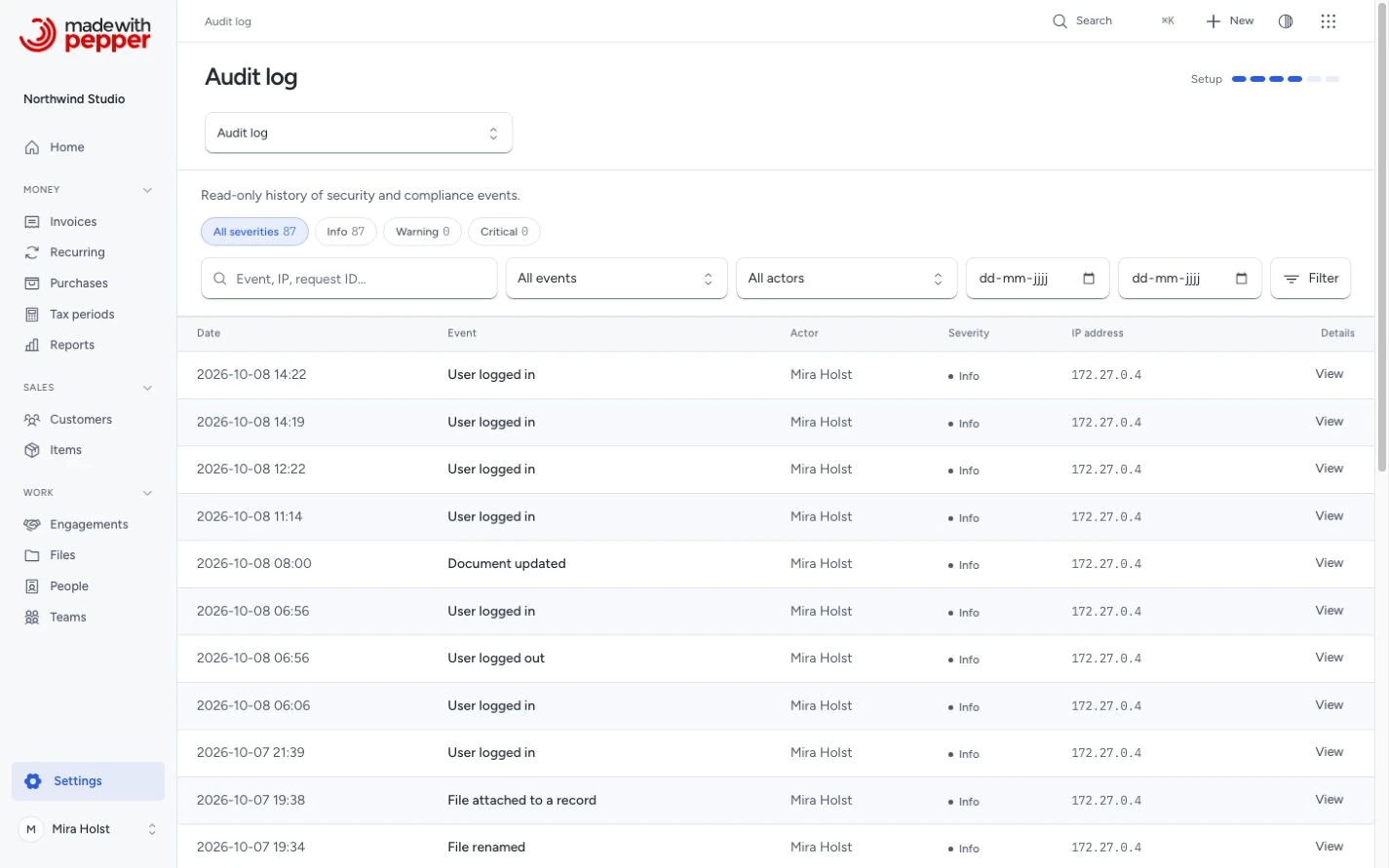
Accessing the audit log
Go to Settings > Audit log. Owners and admins see every event.
An accountant opens the audit log from Your profile and sees only their own events. The page says "Your own actions in Made with Pepper, newest first." It has no Actor filter and names no other person. Employees have no audit log.
The list shows each event with its name in your language, the actor, the severity, the IP address and the date. The date and the time use the company's date format and time format. Chips above the list filter by severity and show the count of each. Click View on a row to open Event details. It shows the event code (for example customer.created), request ID, record, user agent and metadata.
Recorded events
Authentication
- User logged in
- User logged out
- Failed login attempts
- Password reset requested and password reset
- Password changed in the profile
Settings
- Settings updated (with before/after metadata)
- Settings section reset to defaults
- Email template updated or reset, with its language
Users
- User invited, invitation sent again or revoked
- User created from an invitation, updated, deactivated, reactivated or deleted
- Profile updated
- Ownership transferred
Documents
- Document created or updated, for every document type (events
invoice.createdandinvoice.updated) - Document finalized (with document number)
- Quote accepted or declined by the customer
- Quote or pro forma converted to an invoice
- Document cancelled, for every document type (event
invoice.cancelled). A cancelled credit note also records its invoice - Document duplicated, with the source document (event
invoice.duplicated) - Credit note draft created from an invoice (event
credit_note.issued) - Document deleted
- Email accepted by the mail server (event
email.accepted) - Email written to the mail log, with no email sent (event
email.logged) - Email failed (event
email.failed) or result unknown (eventemail.unknown), with severity Warning - Email not sent, for example with no recipient left (event
email.cancelled) - Delivery recorded with Record delivery (event
document.delivery_recorded) - Issued original missing or changed (events
document.artifact_missinganddocument.artifact_changed) - Note added
The email events apply to document emails and reminders. They store the number of recipients and a hash of each address, not the addresses.
Payments
- Payment recorded, for full and partial payments (event
invoice.paid) - Payment reversed, with the amount, the payment date and the reason (event
invoice.payment_reversed) - Refund recorded on a credit note (event
credit_note.refunded) - Refund reversed, with the amount, the refund date and the reason (event
credit_note.refund_reversed)
Reminders and recurring invoices
- Reminder emails, automatic or manual, through the email events above
- Recurring schedule created, updated, paused, resumed or deleted
- Invoice generated from a recurring schedule
Customers, items and settings records
- Customer created, updated or deleted; customers imported or exported
- Item created, updated or deleted; items imported or exported
- Item category created or updated
- Tax rate created, updated, deleted or put in another order
- Bank account created or updated
- Company logo updated or removed
- Invoices exported from the reports
Backups
- Backup created, downloaded, deleted or restored
- Backup settings updated
System
- Application installed
- Update installed
- Update failed
Event details
Each event records:
| Field | Description |
|---|---|
| Event type | What happened |
| Severity | Info, Warning, or Critical |
| Actor | The user who performed the action, or "System" for automated events |
| IP address | The IP address of the request |
| User agent | The browser or client that made the request |
| Request ID | Unique identifier for matching related log entries |
| Timestamp | When the event occurred |
| Metadata | Context for the event type |
Filtering
Filter the audit log by these fields, then click Filter. Click Clear filters to reset them.
The filters are:
- Event type: one exact event. The list offers only events already in the log. The default is All events
- Severity: Info, Warning, or Critical
- Actor: events from a specific user
- From date and To date: limit results to a time period
- Search: free-text search across event names, IP addresses, and request IDs
Localization
You can use the audit log in all 13 languages. The event names are translated. The event codes and the metadata are not.
Related pages
Need help with the product?
Contact support