
Browse the manual
Item catalog
Manage your products and services catalog with categories, default tax rates, and CSV import/export.
On this page
For: business owners building a catalog of products and services.
Where: Items in the navigation, or go to /items.
Item list
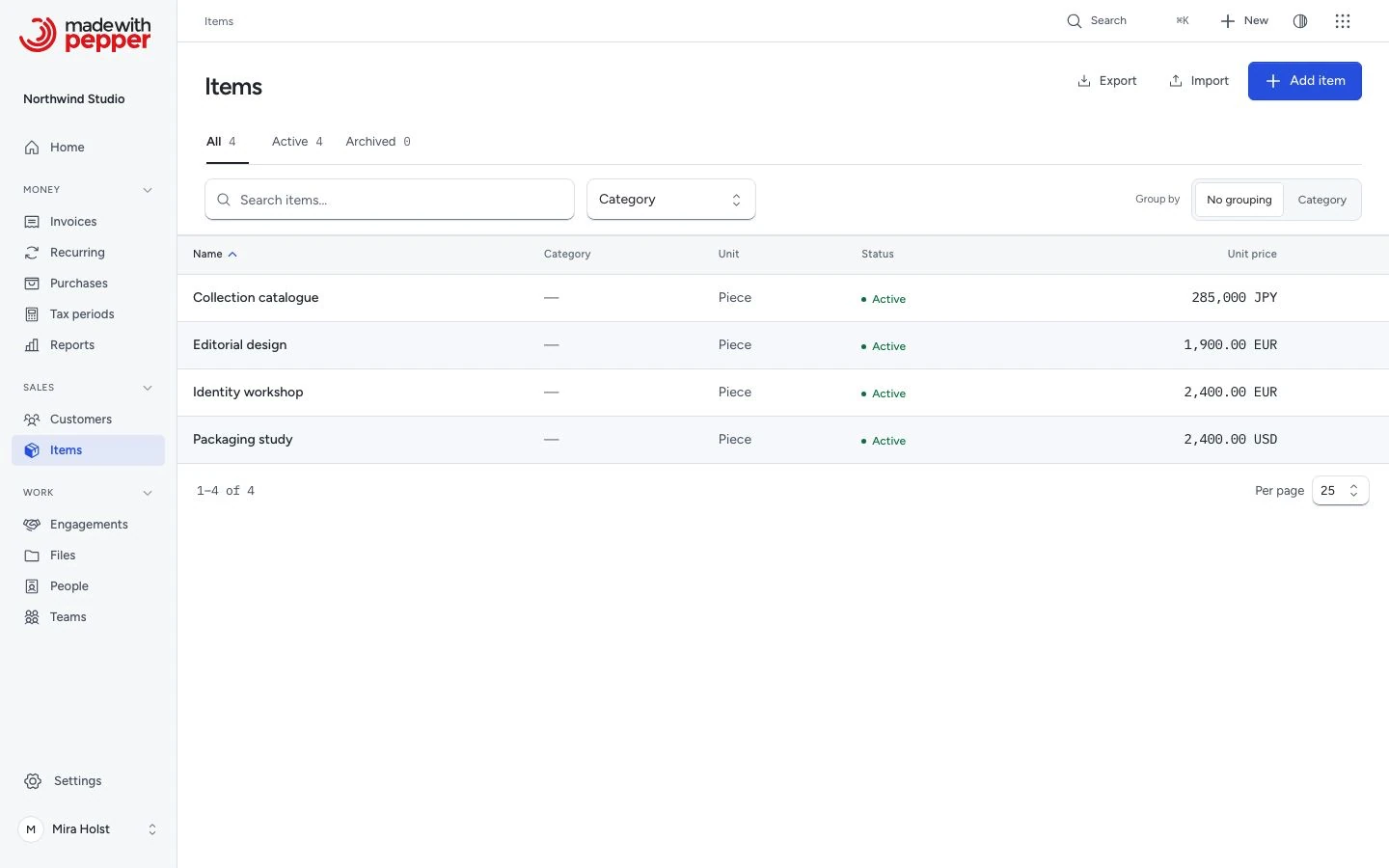
The item list shows the name with its SKU, the category, the unit, the unit price with its currency, and the status (Active or Archived).
- Use the All, Active and Archived tabs above the list at every screen width. Their counts cover the catalog before search and category filters.
- Choose a Category below the tabs. Changing a status tab keeps that category and your search. The selected category follows its dropdown; click it to remove only that filter.
- Each row keeps its own price and currency. Prices in different currencies are never added together.
- Search items filters by name or SKU. Made with Pepper searches on the server, so a long catalog stays fast.
- Click a column heading to sort. The sort, the view, the page and the page size stay in the address, so you can bookmark a view.
- Group by groups the rows by category.
- Below 640 px, each item becomes a compact row with its name, price, state and actions.
If a search or category has no matches, Clear filters removes those criteria and keeps the status tab, sorting and grouping.
Actions on the list page:
- Add item: create a new catalog item.
- Import: upload a CSV file to import items in bulk.
- Export: download the full item list as a CSV file.
- Edit and Delete in each row. Delete asks "Delete name?" first. The item leaves your catalog. Documents that already use it keep their lines.
Creating an item
Click Add item to open the item form. The form has four sections: Item details, Pricing & units, Classification and Status.
| Field | Required | Description |
|---|---|---|
| Name | Yes | Product or service name, shown in autocomplete when adding line items |
| SKU | No | Stock keeping unit or internal reference code |
| Description | No | Default description used when adding this item to an invoice |
| Price currency | Yes | Defaults to your company currency. Saved with the price. A later change to the company currency does not change it |
| Unit price | Yes | Default price per unit, excluding tax, in the price currency. Type it in your number format; the field uses that currency's decimals, for example none for JPY and three for BHD. Invalid text is refused and stays in the field so you can correct it |
| Unit type | No | Unit of measurement: Hour, Piece, Day, Kg, or Custom |
| Default tax rate | No | Applied when you add this item to an invoice. Select an active rate. Manage tax rates opens the settings |
| Category | No | Optional grouping. Select an active category. Manage categories opens the settings |
| Active | Yes | Active items appear in the catalog picker on invoice forms. Archive items you no longer sell |
Click Create item to create the record. If a field is not valid, Made with Pepper keeps what you typed. It lists the errors above the form and at each affected field.
Made with Pepper refuses an archived tax rate or category. An item that already has one keeps it when you save other changes.
Editing an item
Click Edit in the item's row to open its form. Fields are the same as the create form, except the price currency: it is fixed once saved. To sell the same item in another currency, create a separate item. Click Save changes to save. If you leave the form with unsaved changes, Made with Pepper asks you first.
Using items on invoices
When creating or editing an invoice, click Add from catalog in the line items section. Search for an item by name. Selecting it fills the line with the item's name, unit, unit price and tax rate. You can then adjust any field for that specific invoice.
The price is copied only when the item is priced in the invoice currency. An item in another currency shows its currency next to its unit in the picker. Selecting it fills the name, unit and tax rate. The price stays empty, with a note such as "The catalog price is in JPY. Enter the EUR price". The line is not linked to the item. Made with Pepper never converts a price between currencies.
Items are templates. Editing a catalog item does not change line items on existing invoices.
Item categories
Manage categories in Settings > Item categories.
- Create categories with a name and optional description
- Assign items to one category on the item form
- Categories that have items assigned show the item count
- Delete a category to remove the grouping (the items remain)
Active and archived
Toggle the Active switch on the item form to archive or reactivate items. Archived items do not appear in the catalog picker when adding line items to invoices but remain in the system for reporting.
CSV import
Click Import on the item list, or go to /items/import. The import has three stages: upload, column mapping and results.
- Choose a
.csvor.txtfile of up to 5 MB. - Click Upload and preview.
- For each file column, choose its Made with Pepper field in Maps to. Map each field once.
- Click Import items.
Data preview shows the first rows as Made with Pepper reads them. The result shows imported and skipped counts. It lists each skipped row with its reason.
Write prices with digits and a dot for decimals, without grouping: 1234.56, 500, 1.234. A price uses at most the decimals of its currency. Made with Pepper does not guess the format: 99,95 and 1.234,56 are refused with a row error, as is a price above the storable maximum.
Map the currency column to Price currency to save each row's price in that currency. The file may name it currency, currency_code or price_currency. A row with an unsupported code gets a row error. Rows with an empty currency, or a file without a currency column, use your company currency.
Map an Active column to import archived items. Made with Pepper reads the value without regard to case or surrounding spaces:
| Value | Result |
|---|---|
yes, true, 1, active, or the words for yes and Active in your interface language |
Active |
no, false, 0, inactive, archived, or the words for no and Archived in your interface language |
Archived |
| Empty cell | Active |
| Any other value | The row is skipped with the message "“value” is not an accepted value" and the accepted words |
The mapping step lists the accepted values. Without an Active column, all items are active.
A row with an error is skipped and reported by row number with the reason. Rows without errors are imported. If you leave the upload for too long, Made with Pepper asks you to upload the file again.
CSV export
Click Export on the item list page to download all items as a CSV file. Each price uses its own currency's decimals, and the last column, currency_code, names that currency. Importing an exported file recreates each item in its own currency.
A text cell that starts with =, +, -, @, a tab or a line break gets a leading apostrophe ('). A spreadsheet then shows the text and does not run it as a formula. Numbers stay as they are. The import removes the apostrophe again.
Permissions
These are built-in role defaults. Custom roles use their assigned permissions. Guest access also follows the permitted modules and record scope.
- Owner and Admin: all item actions, including import and export
- Employee: create, edit, delete and import items; no export
- Accountant: view the list and export it; no changes
Related pages
Need help with the product?
Contact support